

Three Urgent Care Visits, One Hospitalization, Zero Coordination
GINA World Asthma Day 2026: Access to asthma inhalers is still an urgent need. My patient had three urgent care visits in 3 weeks. Still ended up in the ICU.

Today is World Asthma Day- May 5th, 2026
Seeing the Global Initiative for Asthma (GINA) theme for 2026 made me pause for a moment: “Access to anti-inflammatory inhalers for everyone with asthma- still an urgent need.”
“Still an urgent need.” The word still is what I find quite impressive.
Asthma was first described 2,400 years ago by Hippocrates around 450 BCE. The name derives from aazein, the Greek word for “panting”. He recognized it had environmental triggers and associated it with specific professions, such as metalwork.
We've had effective inhaled corticosteroids (ICS)- the anti-inflammatory inhalers GINA is talking about- since the early 1970s. ICS has been the foundation of asthma treatment for decades and recommended by GINA for persistent asthma.
In 2019, GINA expanded this recommendation to ICS as first-line for all asthma, including mild cases. They declared this “the most fundamental change to asthma therapy in the last 30 years.”
And yet here we are in 2026, with GINA declaring access to ICS therapy is still an urgent need. Not because they don’t work. Not because the evidence is unclear. But because the gap between what we know and what patients actually receive is still wide.
I saw this gap recently in the ICU.
A 35-year-old man- let's call him Mike- was admitted to the ICU with a life-threatening asthma attack. Intubated. On the ventilator for three days.
And as I reviewed his chart, I could trace every step backward where the system failed him. Where knowledge didn’t translate to care, where medication cost, care fragmentation and the absence of a primary care doctor converged into a preventable crisis.
Why the System Doesn’t See the Pattern
Three urgent care visits in three weeks. Two different locations. Two separate medical record systems. Each doctor did exactly what urgent care is supposed to do- treat the acute crisis and discharge.
That’s appropriate for urgent care. But asthma isn’t an acute crisis disease. It’s a chronic disease that requires ongoing treatment by a primary care doctor (or a pulmonologist).
But Mike had no primary care doctor. He had recently been laid off and had no insurance.
At visit #1, he came in short of breath after starting a new part-time warehouse job to make ends meet. Dust, chemicals, poor ventilation. The urgent care doctor gave him a nebulizer treatment, prescribed oral prednisone for 5 days and an albuterol inhaler, and told him to come back if it got worse.
He went back to the urgent care when the symptoms got worse after a week. Again, treated with a nebulizer treatment, another round of prednisone, and told him to come back if it got worse.
By visit #3, Mike was frustrated and tried his luck at a different urgent care. This time the doctor prescribed Symbicort (an ICS controller inhaler), exactly what GINA’s updated guidelines recommend for all adult asthma patients.
He went to the pharmacy. “$400 a month without insurance.”
He walked out without the Symbicort. Continued to use the albuterol inhaler 6 to 8 times per day.
Asthma affects 363 million people worldwide and kills roughly 450,000 every year. Most of those deaths are preventable. And 96% of them happen in low- and middle-income countries- places where ICS inhalers are unavailable, unaffordable, or both.
The medication itself isn’t the problem. ICS inhalers are on the WHO Essential Medicines List. They’re included in the WHO “Best Buys” for non-communicable diseases. We’ve known how to prevent these deaths for fifty years. But barriers still exist around the medication- supply chains, cost, knowledge, continuity of care.
What He Actually Needed (And What the System Missed)
For my patient, Mike, the pharmacy never mentioned he could get the ICS inhaler for $35 (with a manufacturer coupon). They told him it would cost $400. For one inhaler.

Most manufacturers in the US have capped the cost of these inhalers at $35 per month since 2025. Unfortunately, many doctors and pharmacists are unaware and do not offer this as an option to patients.
By week 4, the inflammation in Mike’s lungs was relentless. Albuterol only treats the acute bronchoconstriction- the airway tightening itself. It doesn’t address the underlying airway inflammation, which is what actually drives asthma attacks. Without an inhaled corticosteroid (ICS), that inflammation gets worse every cycle.
Mike eventually went to the ER in severe distress. Airways so tight he could barely move air. Intubated. Admitted to the ICU.
No One Was Looking at the Whole Patient
This is where it gets complicated. Because Mike wasn’t just dealing with one doctor or one system.
Mike needed continuity. Someone looking at the pattern. A primary care doctor who could have coordinated his care. Someone who could have seen him after the 1st urgent care visit and said: “You’ve got asthma triggered by this new warehouse job. You need a daily ICS inhaler. Let’s get you on one today, and I’ll follow up in 2 weeks.”
Instead, urgent care treated three separate crises. Each one correctly, in isolation. But asthma isn’t isolated. It’s cumulative. And if left untreated, it can become a life threatening exacerbation that lands someone in the ICU.
What Changed After the Ventilator
Mike came off the ventilator knowing he’d nearly died. He's now paying $35 a month for Symbicort (ICS/formoterol inhaler) with a manufacturer coupon. He started seeing a new primary care doctor
And he went back to the warehouse.
This is important. He didn’t need to leave the job. The dust didn’t disappear. But now he’s on a daily ICS/formoterol inhaler and his asthma is controlled enough that the dust exposure isn't triggering attacks. His manager also moved him to areas with less dust, which has definitely helped.
Whether Mike has work-exacerbated asthma (his baseline disease worsened by the job) or true occupational asthma (he developed it from the work exposure) matters for long-term management. GINA recommends eliminating exposure for true occupational asthma. But for now, with the daily ICS inhaler in place and accommodations made, he’s stable.
In an ideal world, Mike would’ve never needed the ventilator. He would’ve gotten the ICS inhaler at urgent care visit #1. He would’ve gotten a primary care follow-up a week later and help to coordinate his care. He would’ve gotten help getting his inhaler cost covered at the pharmacy.
GINA 2026 World Asthma Day: Access Remains an Urgent Need
GINA’s theme comes back to me as I think about this case. “Access to anti-inflammatory inhalers for everyone with asthma- still an urgent need.”
But access is not just about availability. It’s about affordability. It’s about knowing the medication exists. It’s about having someone tell you about the $35 manufacturer coupon when you’re standing at the pharmacy counter unable to afford $400.
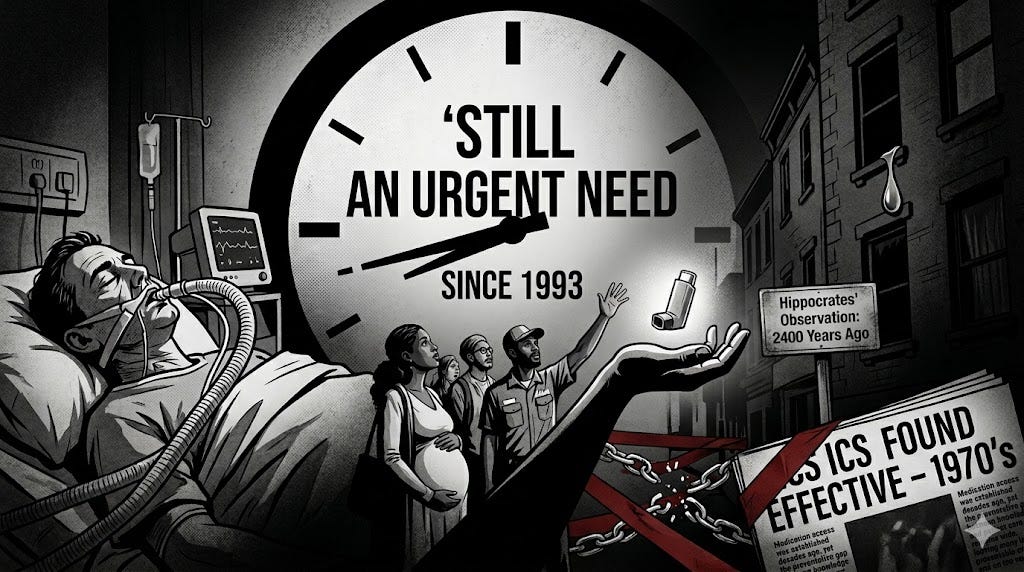
We've known for 2,400 years that asthma is real. Hippocrates recognized its environmental triggers. We’ve known for 50 years that ICS inhalers work. We’ve had guidelines recommending ICS inhalers since GINA was founded in 1993.
Since 2019, GINA guidelines have been explicit: ICS first-line, for all asthma. Not albuterol alone. Not rescue-only.
And yet the gap between what we know and what patients receive persists.
Mike survived. The system that nearly killed him is unchanged.
The next patient who walks in without insurance, without a primary care doctor, without anyone to mention medication copay assistance- in a new job, in a dusty warehouse, with a cough and chest tightness that won’t quit. They will move through the same fragmented loop. Three urgent care visits. Three rounds of prednisone. An ICS inhaler prescription they can’t afford. A pharmacy counter where no one mentions the $35 coupon.
Will they end up intubated? Some of them. Will they have a crisis? Most of them. Will the system see the pattern? No.
But the pattern is preventable. We’ve known how to prevent it for 50 years.
Mike was lucky enough to end up in the ICU, where someone finally connected the dots.
That shouldn’t be what it takes.
Frequently Asked Questions
Q: What’s the difference between rescue inhalers (albuterol) and controller inhalers (ICS)?
A: Rescue inhalers like albuterol open airways during an attack by relaxing the muscles around the airways. They work in minutes but don’t prevent attacks or flares. Controller inhalers contain inhaled corticosteroids (ICS) that reduce the underlying inflammation causing asthma. They take days to weeks to work but prevent attacks from happening in the first place. GINA 2026 guidelines say all asthma patients except the youngest children need a controller. Albuterol rescue-only therapy leaves the inflammation untreated and that inflammation worsens with each cycle.
Q: Why didn’t the urgent care doctor prescribe a controller at the first visit?
A: Urgent care is designed for acute problems- treat the crisis, discharge the patient. Controllers require longitudinal management: follow-up visits, adjustments, monitoring. That happens in a primary care clinic (or a pulmonary clinic). The system broke down because this patient had no primary care doctor. Urgent care treated three separate crises without anyone connecting the pattern. If a primary care physician had seen him, the conversation would have been: “You’ve got occupational asthma from this new job. You need a controller to prevent these attacks.” One controller at Visit #1 probably would have prevented him from ending up in the ICU.
Q: How much do asthma inhalers cost, and are there copay assistance programs?
A: Controller inhalers like Symbicort (budesonide/formoterol) cost $250-400 monthly without insurance. But most manufacturers offer patient assistance programs that reduce the cost to $35 monthly for uninsured or underinsured patients. The problem in this case: nobody told the patient these programs existed. The pharmacy quoted the retail price, and he made a rational decision- he couldn’t afford it. If the doctor or pharmacist had mentioned copay assistance, it wouldn’t be a problem. These programs aren’t secret, but also not openly promoted by manufacturers.
Q: What is occupational asthma, and how is it different from regular asthma?
A: Occupational asthma is asthma caused by exposure to workplace irritants (dust, chemicals, fumes). Some people have baseline asthma that gets worse with exposure- work-exacerbated asthma. Others develop asthma for the first time because of the job- true occupational asthma. Occupational asthma is estimated to be 10-15% of asthma cases worldwide.
In this patient’s case, warehouse dust and chemicals probably triggered or worsened existing asthma. GINA recommends eliminating exposure for true occupational asthma when possible. But managing workplace asthma also means a good daily controller inhaler and workplace accommodations- fewer hours in dusty areas, better ventilation, PPE.
Q: How do I know if I should be on a controller inhaler?
A: If unsure, ask your doctor: “Am I on a daily controller inhaler?” If you have asthma and you’re only using rescue inhalers (albuterol), you probably should be on a controller (ICS inhaler). GINA recommends controllers for all asthma patients except the very youngest.
Signs you might need a controller- using albuterol rescue inhaler more than twice a week, waking up at night with asthma symptoms, having asthma symptoms with exercise or cold air. If your doctor hasn’t recommended a controller, ask why. If cost is the barrier, ask about manufacturer copay coupons or cheaper generic options.
Q: What should I do if I can’t afford my asthma inhaler (in the US)?
A: Discuss with your doctor or pharmacist. Options include:
(1) Copay assistance programs- most manufacturers offer them; call the manufacturer or visit their website;
(2) Generic versions may be cheaper;
(3) Different ICS medications- some insurance plans cover certain inhalers more cheaply or at a lower tier than others;
(4) Discount programs like GoodRx or Cost Plus Drugs;
(5) Prescription assistance programs are available through medicare and at state level, if you meet low income thresholds.
Don’t stop taking your daily controller inhaler because you can’t afford the out-of-pocket price, until you exhaust all options.
Q: Can asthma be cured?
A: No, but it can be very well controlled. A well-managed asthma patient on a controller inhaler may have no symptoms at all. They can exercise, work in challenging environments (with accommodations), and live normal lives. Their lung function testing will look normal. This patient went back to the warehouse after his ICU stay. He was stable because now he was on a controller. The goal isn’t to cure asthma- it’s to control it so well that it doesn’t control you.
The patient described in this article is a composite based on real clinical experience. Identifying details have been changed to protect privacy. This article is for general educational purposes only and does not constitute medical advice, diagnosis, or treatment. Reading this article does not establish a physician-patient relationship. Treatment decisions should be made in consultation with your own physician based on your individual medical history and circumstances. The views expressed are my own and do not represent the views of my employer or any institution with which I am affiliated. References to GINA guidelines, manufacturer copay assistance programs, and medication costs reflect publicly available information at the time of publication and may change. If you are having difficulty breathing or experiencing a medical emergency, call 911 or seek immediate emergency care.
References
Global Initiative for Asthma. World Asthma Day 2026: Access to Anti-Inflammatory Inhalers for Everyone with Asthma — Still an Urgent Need. GINA, 2026. https://ginasthma.org/world-asthma-day-2026/
Global Initiative for Asthma. 2025 GINA Strategy Report and Summary Guide for Asthma Management and Prevention. GINA, 2025. https://ginasthma.org/reports/
World Health Organization. Asthma — Fact Sheet. WHO, updated April 2026. https://www.who.int/news-room/fact-sheets/detail/asthma
World Health Organization. Working Together to Make Asthma a Global Health Priority. WHO News, May 2025. https://www.who.int/news/item/06-05-2025-working-together-to-make-asthma-a-global-health-priority
Mortimer K, Reddel HK, Pitrez PM, Bateman ED. Asthma management in low and middle income countries: case for change. European Respiratory Journal. 2022;60(3):2103179. https://pubmed.ncbi.nlm.nih.gov/35210321/
Crompton G. A brief history of inhaled asthma therapy over the last fifty years. Primary Care Respiratory Journal. 2006;15(6):326–331. https://www.nature.com/articles/pcrj2006092
Reddel HK, Bacharier LB, Bateman ED, et al. Global Initiative for Asthma Strategy 2021: Executive Summary and Rationale for Key Changes. American Journal of Respiratory and Critical Care Medicine. 2022;205(1):17–35. https://pmc.ncbi.nlm.nih.gov/articles/PMC8865583/
Reddel HK, Taylor DR, Bateman ED, et al. A summary of the new GINA strategy: a roadmap to asthma control. European Respiratory Journal. 2015;46(3):622–639. https://pubmed.ncbi.nlm.nih.gov/26206872/
Marketos SG, Ballas CN. Bronchial asthma in the medical literature of Greek antiquity. Journal of Asthma. 1982;19(4):263–269. https://pubmed.ncbi.nlm.nih.gov/6757243/
Centers for Disease Control and Prevention. Most Recent National Asthma Data. CDC, 2024. https://www.cdc.gov/asthma/most_recent_national_asthma_data.htm
This Q&A section should be required reading for physicians and patients. Thanks for explaining the different inhalers and cost savings programs so succinctly. Information about asthma management is literally life-saving.
OMG am I Mike?! 10 ER trips for not being able to breathe in 2025.
Discharged over my objection for anxiety.
Finally took an uber to Temple instead of Bryn Mawr… the new hospital did the testing the first never would.
Small airways disease, emphasyma, thickening of bronchial walls, mucus plugging, hyperinflation, air trapping.
My PCP had discharged me for being a “bad fit” in the middle of it all, so I didn’t have primary care from last October until a month ago. The very time my lungs progressed to damage that can’t be undone.
Wrote about it: https://dispatchfromthemiddle.substack.com/p/i-was-not-fine
I think Mike and I need to hang out.