
What Is the DISC Framework? Why Medicine Needs It
The behavioral tool 70% of Fortune 500 companies use — and that most hospitals reserve for executives who never see patients.

Last week I told you about a deteriorating post-CABG patient trending toward intubation, a conversation with the surgeon that felt like a negotiation rather than a shared decision, and a plan that fractured quietly between two sets of attending notes. Nobody Dropped the Ball. So Why Did the Plan Almost Fall Apart?
If you missed Part 1, read it first for context.
This week we’ll talk about the DISC assessment as a framework to understand the miscommunication that was happening, what the research says, and what you can practically do with it starting today.
What Is the DISC Framework? The Origin of the Model
DISC is a behavioral style model built on research from a 1928 book called Emotions of Normal People by psychologist William Marston. His observation was that you could understand how someone communicates by watching how they respond to four things: problems, pace, people, and procedures.¹
The framework describes four behavioral tendencies — not fixed personality types, not a diagnostic label. Tendencies. How people prefer to process and deliver information, shaped partly by who they are and partly by what their environment has reinforced over years.
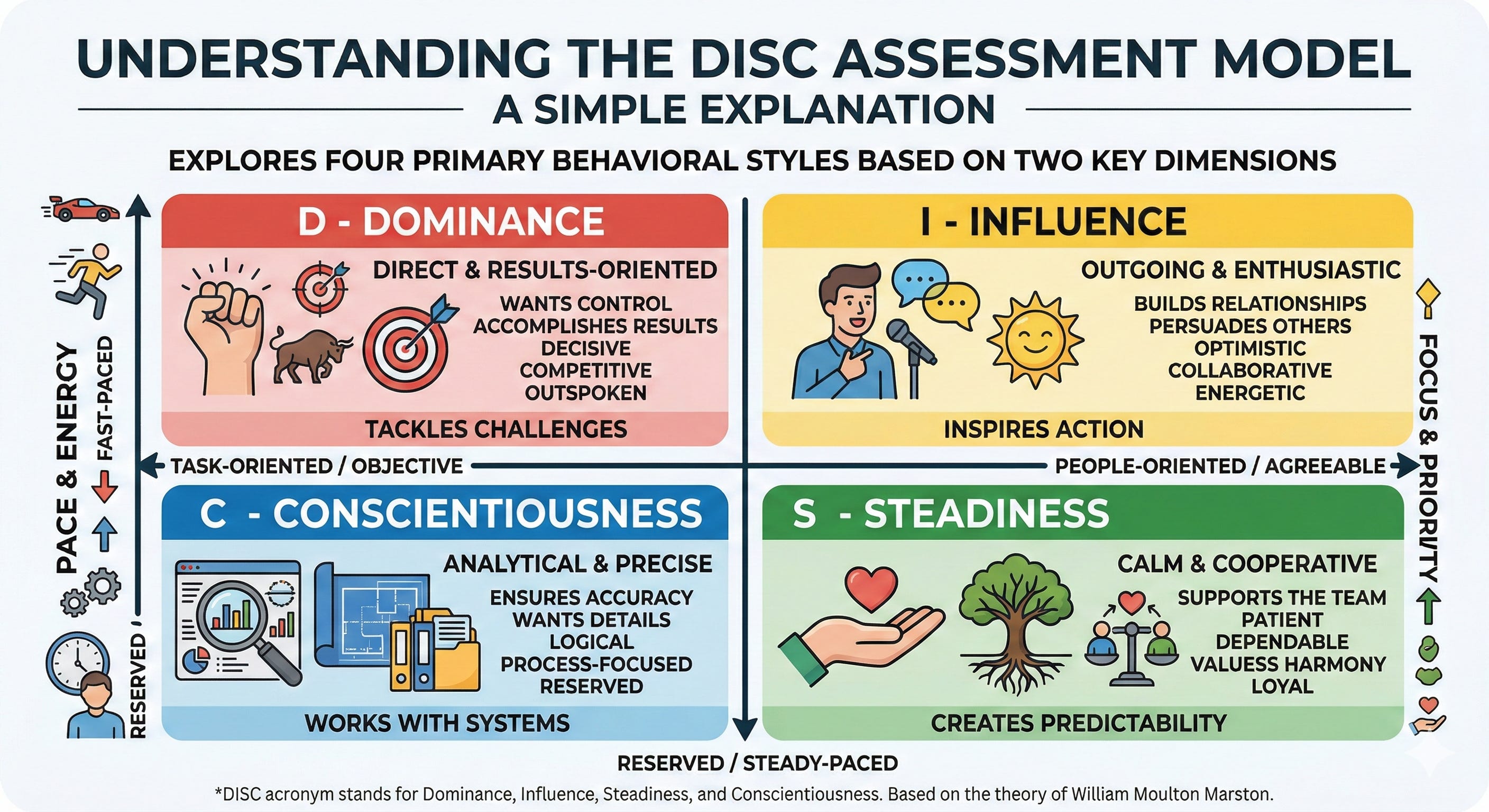
D — Dominance. Direct, decisive, results-oriented, action-biased. D-style communicators want the bottom line fast. They form positions quickly and push toward resolution. Ambiguity is uncomfortable — not because they’re impatient by nature, but because in their professional world, delay has real consequences.
I — Influence. Enthusiastic, relational, optimistic, energized by people. I-style communicators lead with connection. They read rooms well. Their vulnerability is follow-through on detail.
S — Steadiness. Patient, consistent, process-oriented, attuned to the people around them. S-style communicators notice things others miss — the small change in a patient’s work of breathing at hour three, the quiet signal that gets charted three times before anyone acts on it. Their vulnerability is that their concern often travels through channels that require others to be paying close attention.
C — Conscientiousness. Analytical, precise, evidence-driven. C-style communicators want to understand the full picture before committing to a recommendation. They build toward conclusions. Their vulnerability is that this process can read as indecision to someone who has already formed a position.
Most people are a blend. I run S/C — methodical, relationship-aware, deeply uncomfortable with being pushed to compress a complex situation into a forced timeline. Which explained, among other things, that phone call with the D-style surgeon in Part 1.
Does DISC Work in Healthcare? What the Evidence Shows
Before I go further, I want to be honest about something.
DISC is not a validated clinical diagnostic tool in the same way that an EKG is. The evidence base is not homogeneous, and some researchers have raised legitimate questions about its predictive validity.²
However, DISC remains a widely-used behavioral framework across a variety of industries — corporate HR, talent management, sales, real estate, financial services, law firms. The Wiley Everything DiSC brand alone reports over a million people take the assessment every year. A frequently cited statistic is that roughly 70% of Fortune 500 companies use some version of DISC.⁸ It's also used in over 90 countries.⁸ Given that there are dozens of competing versions beyond the Wiley brand, total annual usage is likely several million assessments globally.
Now there is a growing body of practice-based evidence in healthcare settings. It is used most heavily in two contexts- leadership development programs (CMOs, department chiefs, section heads) and hospital HR/onboarding. The American Association for Physician Leadership (AAPL) actively promotes DISC for physician leaders. There is enough signal that medical educators are starting to take it seriously.
A 2019 publication in the Journal of Surgical Education integrated DISC into general surgery residency leadership training at Rutgers RWJ Medical School. After a year, 96% of residents agreed the tool was useful.³ More telling: before the curriculum, only 22% of those same residents felt they had received adequate communication training³ — despite the fact that interpersonal and communication skills is one of the six core competencies required by the ACGME.⁴
A 2025 paper (also from Rutgers) in the Journal of Surgical Education mapped a full DISC curriculum to the Kern six-step framework for curriculum development in surgical residency, finding it provided a practical structure for communication training across multiple clinical settings — OR, emergency consults, multidisciplinary rounds.⁵
At Mount Sinai Beth Israel, a DISC workshop for 79 internal medicine residents across the 2022–23 academic year found that months after a single half-day session, all respondents reported feeling prepared and confident to apply what they'd learned.⁶
An older 2011 study found associations between DISC profiles and OB/GYN resident performance: residents who performed well on high-stakes examinations tended toward high D and C — decisive and precise — while those who struggled often had profiles mismatched to the demands of the specialty.⁷
None of this is definitive. But it’s enough to take seriously — particularly when the alternative is what we currently do, which is give people no framework at all and expect them to figure out cross-specialty communication through trial and error with patient care hanging in the balance.
Why Surgeons and Intensivists Communicate Differently
There is some evidence that suggests different medical specialties attract — and then further reinforce through training and practice — different behavioral tendencies.¹⁰ In my experience, surgeons cluster heavily toward D: a field where a moment’s hesitation in the OR has direct consequences selects for action-orientation and trains it over years. Pulmonologists like myself tend toward S/C — our work is chronic disease, iterative reasoning, long patient relationships. Primary care shows strong S representation. Radiology and pathology usually cluster towards C.
This means every cross-specialty interaction is also a cross-cultural communication event.
The CT surgeon on that phone call in Part 1 wasn’t being obstructionist. He was operating in his native communication language — direct, decision-forcing, oriented toward resolution. I wasn’t being indecisive. I was building toward a recommendation in mine — process-first, shared understanding before commitment.
Neither of us was wrong. Neither of us had a vocabulary for what was happening.
How to Adjust Your Communication Style by Specialty
If I know I’m calling a D-style surgeon, I restructure the conversation entirely.
I don’t build toward my recommendation — I lead with it: “He needs gentle diuresis tonight. Here’s the reason why, here’s the specific ask, here’s what we’re monitoring for. If any of these numbers move, I call you directly.” The D-style brain can work with that. It has a defined ask, a monitoring plan, and a decision point.
Flip it: if the surgeon knows he’s talking to an S/C intensivist, he reframes his opening. Instead of “what exactly are you proposing” — which an S/C hears as pressure to skip steps — he might try: “Walk me through what you’re seeing and what you need from me to feel confident about the plan.” That framing gets to the same place faster, counterintuitively, because the S/C no longer needs to spend half the conversation establishing that the full picture matters.
This extends to the consult note too — one of the most important communication artifacts in medicine, and one nobody teaches you to write for your audience.
A good consult for a D-style surgeon is not the same document as a good consult for a C-style neurologist.
The surgeon wants the diagnosis, the specific ask, and the one critical action in the first two lines. The neurologist wants the differential, the data trail, the reasoning chain.
Most of us write consult notes in our own style and then feel confused when the response doesn’t match what we expected.
My default is to build the picture before I land on the recommendation. I’ve actively pushed myself to write the conclusion first. It doesn’t feel natural. But it gets the information where it actually needs to go.
How to Use DISC in Clinical Practice: A Starting Point
Take a free DISC assessment such as this one, takes about 10 to 15 minutes. Maybe ask two colleagues from different specialties to do the same. Have one honest conversation about what came up.
At its most useful, DISC is a prompt. It gets you thinking about how you communicate, how the people around you communicate, and why those two things don't always line up the way you'd expect.
A word on the criticisms of DISC, because they matter: the evidence that DISC predicts clinical performance or competence is weak, and I wouldn't use it that way.² What it does reliably is something more modest — it opens conversations that wouldn't otherwise happen, and it gives people a vocabulary for friction they've felt their entire career but never had words for. That's the use case I'm endorsing here.
None of what DISC describes will be new to you — the experiences are familiar. What's new is having a framework for them. The patient hand-off that unraveled quietly. The consult call that ended in tension rather than alignment. The family meeting where everyone was physically present and nobody was actually on the same page. These aren’t failures of character or competence. They are different communication styles operating in the same room without a shared language.
DISC won't solve medicine's communication problems. But naming what's happening in the room is the first step toward changing it — and this gives you a way to do that in real time, with the people you're already working with.
References
1. Marston WM. Emotions of Normal People. Kegan Paul, Trench, Trubner & Co., 1928. (DISC model origin)
2. Wikipedia — DISC Assessment: Overview and limitations of predictive validity
8. Physician Study Links DISC Personality Type to Job Performance. DISCInsights / PeopleKeys.
9. Open Psychometrics — Free DISC-style assessment used in medical education curricula
LUNGSPAN © 2025 | lungspan.substack.com
This is such a high-signal list because it’s not “wellness theater; it’s mostly the boring foods that keep paying rent metabolically. What I especially like is the mix of gut-specific wins (kiwis, kefir, yoghurt, crucifers) with foods that also protect the bigger terrain, such as arteries, brain, insulin sensitivity, inflammation. The kiwi point is great because it’s so practical: a food that can genuinely move bowel function without turning into a dependency loop. And the overall message lands: consistency beats perfection. I also appreciate the egg section. So much nutrition discourse is still lagging behind the evidence, and your “redemption story” framing is exactly how many clinicians feel watching old cholesterol fears outlive the data. If I were adding one line for readers, it would be this: the power here isn’t in finding the single “best” food. It’s in building a default pattern where fiber, protein, fermented foods, omega-3s, and polyphenols show up so regularly that your gut and metabolic system stop having to negotiate with chaos every day.