
Does Mullein Help COPD? A Pulmonologist Reviews the Evidence
My patient stopped using his inhaler. His breathing got better. Here's what was really going on.

“Doc, I haven’t used my inhaler in three weeks.”
Tom, a 67-year-old with moderate COPD (chronic obstructive pulmonary disease—a progressive lung condition that makes breathing difficult), looked healthier than I’d seen him in two years. His breathing was easier, his cough had diminished, and he’d even started walking his dog again.
“What changed?” I asked, expecting to hear about him finally quitting smoking cigarettes or starting pulmonary rehab.
“Mullein tablets. My sister told me about them.”
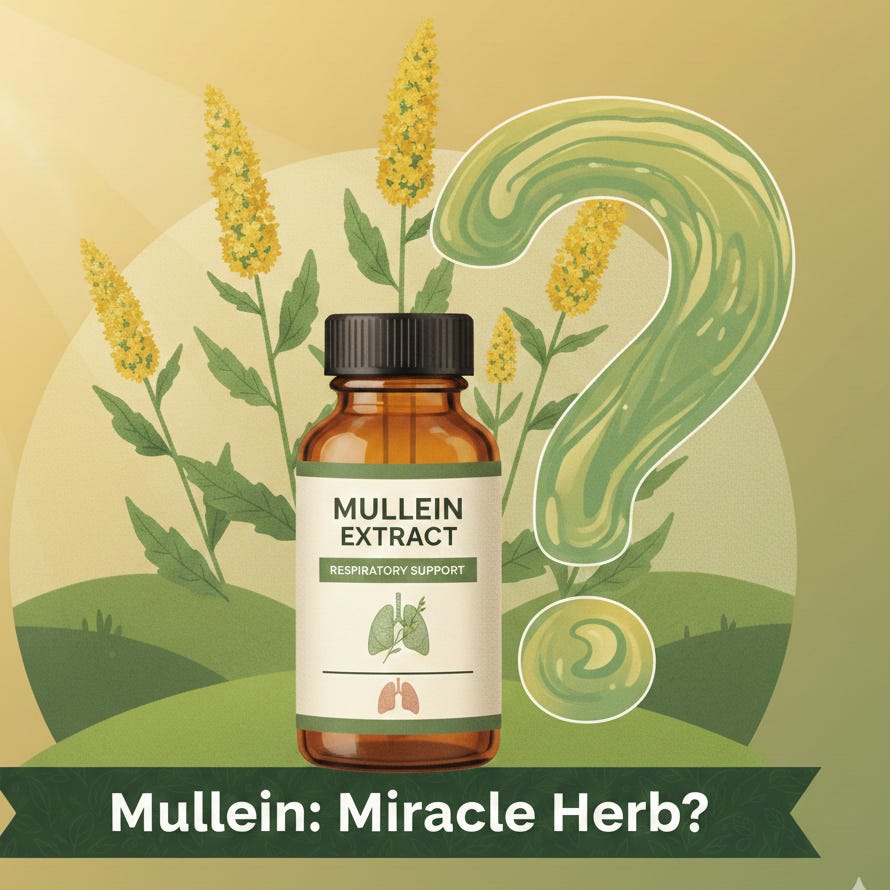
His pulmonary function tests had actually improved—not dramatically, but measurably. So I did what any good doctor should do: I looked at the data.
What the Research Actually Shows
Let me be straight: There are no high-quality clinical trials on mullein for COPD. None.
Mullein (Verbascum thapsus) contains compounds that theoretically could have anti-inflammatory properties. We have some laboratory studies and centuries of traditional and folk medicine use, but that’s not the same as clinical evidence.
FACT-CHECK: Laboratory studies show anti-inflammatory properties in vitro. However, there are NO randomized controlled trials demonstrating efficacy for COPD in humans. A 2016 literature review found that the only clinical study ever conducted on mullein for respiratory conditions was from Dublin, Ireland in the early 1800s—and it only included seven patients.
So Why Did Tom Improve?
When I dug deeper, here’s what emerged:
Other changes he made: He’d cut smoking from 20 to 5 cigarettes daily, started the mullein when spring arrived (his COPD always improves with warmer weather), began daily walks, and became more consistent with his maintenance inhaler.
The placebo effect: Believing something will help produces real, measurable improvements. Studies show placebos can improve lung function (FEV1) by approximately 4.2% in asthma patients, with much larger effects (25-31%) on subjective symptoms like breathlessness.
Natural disease variability: Chronic lung disease symptoms fluctuate. Without controlled comparison, we can’t know if the supplement caused improvement or just coincided with it.
It might actually help (a little): I can’t rule this out. We just don’t have data to know for sure.
The Real Risks
Drug interactions: Mullein contains coumarins, which theoretically could increase bleeding risk when combined with blood thinners like warfarin.
Quality concerns: A 2013 study found 59% of herbal supplements contained plant species not listed on labels. A 2021 study found ~60% contained fungal isolates.
False security: My biggest concern is patients replacing proven treatments with unproven supplements. That’s dangerous.
What Actually Works for Chronic Lung Disease
Proven to help:
Pulmonary rehabilitation programs
Regular exercise and breathing techniques
Vaccinations including flu and pneumoccocal
Quitting smoking
Possibly helpful (some limited evidence):
N-acetylcysteine (NAC)
Vitamin D supplementation (if deficient)
Omega-3 fatty acids
Unproven but low-risk: Mullein, if used alongside proven treatments
Six Months Later
Tom came back having stopped smoking completely and joined pulmonary rehab. He was still taking mullein. His lung function had improved another 8%.
“Is it the mullein?” he asked.
“Honestly? Probably not primarily. It’s more likely because you quit smoking and started rehab. But if you want to keep taking it and it’s not causing problems, I’m not going to tell you to stop.”
The Bottom Line
There’s no scientific evidence that mullein treats COPD or chronic lung disease. But there’s also limited evidence it causes harm when used sensibly alongside proven treatments.
If you have COPD or chronic lung disease:
Don’t replace prescribed medications with supplements
Talk to your doctor before adding anything new
Focus first on proven interventions
Monitor symptoms objectively if you try supplements
The most important thing Tom did wasn’t taking mullein. It was taking control of his health—walking daily, cutting out cigarettes, staying consistent with his medications.
Sometimes the supplement isn’t the medicine. The decision to take better care of yourself is.
Medical Disclaimer: This is educational content, not personal medical advice. Always consult with your health care provider before starting or stopping any treatments for medical conditions.
References
Mullein Background & Traditional Use:
Turker AU, Gurel E. Common mullein (Verbascum thapsus L.): recent advances in research. Phytother Res. 2005;19(9):733-739.
Blanco-Salas J, Hortigón-Vinagre MP, Morales-Jadán D, Ruiz-Téllez T. Searching for Scientific Explanations for the Uses of Spanish Folk Medicine: A Review on the Case of Mullein (Verbascum, Scrophulariaceae). Molecules. 2021;26(13):3798.
Clinical Evidence (Lack Thereof):
Karman R. Assessing the Effectiveness of Mullein on Respiratory Conditions Such as Asthma. ResearchGate. 2016.
Placebo Effects in Respiratory Disease:
Luc F, Stokes J, Azim A, et al. Placebo effects in clinical trials evaluating patients with uncontrolled persistent asthma. Ann Am Thorac Soc. 2019;16(12):1557-1563.
Supplement Quality & Safety Concerns:
Newmaster SG, Grguric M, Shanmughanandhan D, et al. DNA barcoding detects contamination and substitution in North American herbal products. BMC Med. 2013;11:222.
Screening for consistency and contamination within and between bottles of 29 herbal supplements. PLoS One. 2021;16(11):e0260463.
Risks and Benefits of Commonly Used Herbal Medicines in México. Toxins (Basel). 2008;5(6):1755-1771. PMC2322858.
NAC Evidence (for comparison):
Cazzola M, Calzetta L, Page C, et al. Influence of N-acetylcysteine on chronic bronchitis or COPD exacerbations: a meta-analysis. Eur Respir Rev. 2015;24(137):451-461.
Poole P, Sathananthan K, Fortescue R. Mucolytic agents versus placebo for chronic bronchitis or chronic obstructive pulmonary disease. Cochrane Database Syst Rev. 2019;5(5):CD001287.
Effect of high-dose N-acetylcysteine on exacerbations and lung function in patients with mild-to-moderate COPD. Nat Commun. 2024;15:8327.
Treatment Guidelines:
Global Initiative for Chronic Obstructive Lung Disease (GOLD). Global Strategy for the Diagnosis, Management, and Prevention of COPD. 2024 Report.